
Teacher Identity
Contact:
224.628.3406
aeluc@butler.edu
anastasia.luc@gmail.com
LinkedIn: www.linkedin.com/in/anastasialuc
Beliefs About Learning Styles
Education is a tapestry woven together by the many languages of children
No two children are the same. Each child has a unique capability for developing new ideas, and each child processes newly learned information is a variety of ways. As a teacher, I believe this is beautiful. Children have many ideas on how to present what they are learning to their peers, and I believe that a teacher's goal is to support his/her children in any way. I remember back to when I was a child, and when it was time to become assessed, my teacher would come by and dump a stack of worksheets on my desk. While I believe that offering class-standard formative assessments is necessary, I wonder if uniform assessments are the only means for a child to showcase what he or she has learned. When I plan both formative and summative assessments, I love when I give the child an opportunity to have choice in how she/he expresses her/himself.
Carlina Rinaldi once said, "When we say that school is not a preparation for life but is life, this means assuming the responsibility to create a context in which words such as creativity, change, innovation, error, doubt, and uncertainty, when used on a daily basis, can truly be developed and become real." I believe that when we give children the opportunity to innovate, create, and change, and we provide the safety for children to have error, doubt, and uncertainty, we are designing our instruction around the expressive needs of the child. Some individuals may think that school is one big puzzle. Each child has her/his puzzle piece, and together they build one, beautiful puzzle. To me, I don't see these puzzle pieces -- these learning experiences -- to fit as one uniform experience. Instead, I envision a tapestry in which the puzzle pieces are fit cohesively and beautifully together to showcase the differently pathways traveled by each child. In my teaching, I plan to offer many opportunities for formative and summative assessment to support students in their conceptual understandings.
I believe that there can be joy in education. Why not start at assessment?
"When we say that school is not a preparation for life but is life, this means assuming the responsibility to create a context in which words such as creativity, change, innovation, error, doubt, and uncertainty, when used on a daily basis, can truly be developed and become real."
-Carlina Rinaldi

Spring 2015 -- Children enjoying outdoor play
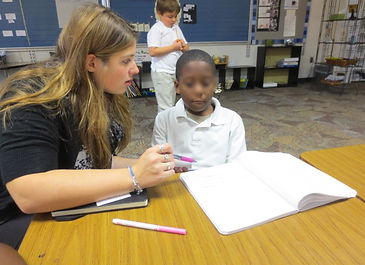
Fall 2013 -- Ms. Luc and a learner working together on short vowel sounds
Thinking about ISTEP+ Testing
One idea I keep in mind while lesson planning is the ISTEP+ testing that students participate in each Spring. While I don't prepare my students with sole skill-and-drill worksheets and excercise, I design my instruction in ways that allow children to make thoughful and meaningful learning connections that they will confidently transfer to their ISTEP+ testing. I provide a variety of learning opportunities to familiarize my students with the format of the ISTEP+ testing. Overall, I plan my curriculum to ensure that authentic learning experiences, as well as learning experiences that directly prepare students for ISTEP+ testing, spiral throughout the year. With my instruction, I plan for my students to take their knowledge with them, and use what they have learned in their ISTEP+ tests, and in their everyday lives.
"No Way. The Hundred is There."
The Hundred Languages
Loris Malaguzzi
No way. The hundred is there.
The child
is made of one hundred.
The child has
a hundred languages
a hundred hands
a hundred thoughts
a hundred ways of thinking
of playing, of speaking.
A hundred always a hundred
ways of listening
of marveling, of loving
a hundred joys
for singing and understanding
a hundred worlds
to discover
a hundred worlds
to invent
a hundred worlds
to dream.
The child has
a hundred languages
(and a hundred hundred hundred more)
but they steal ninety-nine.
The school and the culture
separate the head from the body.
They tell the child:
to think without hands
to do without head
to listen and not to speak
to understand without joy
to love and to marvel
only at Easter and at Christmas.
They tell the child:
to discover the world already there
and of the hundred
they steal ninety-nine.
They tell the child:
that work and play
reality and fantasy
science and imagination
sky and earth
reason and dream
are things
that do not belong together.
And thus they tell the child
that the hundred is not there.
The child says:
No way. The hundred is there.
Throughout my junior year of college, I studied the Reggio Emilia approach intensively. I didn’t anticipate how much I would connect to the Reggio Emilia approach. I always thought that Loris Malaguzzi’s poem, "The Hundred Languages of Children", was beautiful, but I never realized how much of my philosophy regarding assessment would be affected by this simple poem – and that’s why I like it. There is a simple beauty to it that draws one in. This poem is what encouraged me to finally destroy the idea that assessment is only a test. Yes, there are some paper and computer tests that children need to and will be familiarized with, but assessment and learning doesn’t need to be defined only by these assessments. A test is only one lens to view a child through, and there are so many more out there. Since hearing Malaguzzi’s poem, I have challenged myself to take the extra steps and offer many different assessments, and allow children to have voice in their learning.
This poem was so powerful to me when I first thought about it in the Fall of 2013. Because it impacted me so much, I looked at Malaguzzi’s poem, and I crafted my own poem in response to his. It’s title? "The Thousand Languages."